The Frequency of Truth: How Women Sound Designers Are Rewriting What American Cinema Sounds Like
There is a moment in nearly every great film when the sound drops away. Not silence, exactly—but a narrowing of the world, a pulling inward, a shift in acoustic perspective that tells the audience something the image alone cannot. That moment is almost never accidental. It is the result of deliberate, sophisticated craft. And increasingly, that craft belongs to women.
Sound design is the discipline Hollywood most often forgets to credit and least often invites women to lead. According to data compiled by the Annenberg Inclusion Initiative, women represent a fraction of the sound department workforce across major studio productions, and the numbers at the supervisory level remain stubbornly, almost defiantly, low. Yet within that constrained landscape, a cohort of women sound designers, supervising sound editors, and re-recording mixers are doing some of the most conceptually ambitious work in American cinema today—work that does not merely accompany the image but actively interrogates it.
What Sound Does That the Camera Cannot
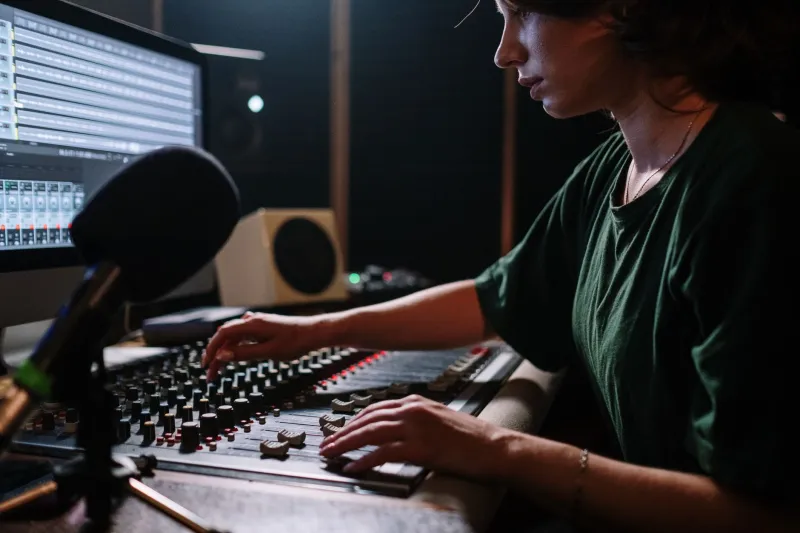
To understand why women's presence in sound design matters, it is worth understanding what sound design actually does. The discipline encompasses everything the audience hears that is not dialogue recorded on set: ambient environments, Foley effects, designed soundscapes, and the intricate mixing of all these layers against score and voice. A sound designer does not simply add noise to a picture. She builds the interior logic of a film's world—deciding what is audible, what is muffled, what is absent, and what those choices mean for the audience's emotional and psychological experience.
This is, in the most literal sense, a question of perspective. Whose point of audition does the film privilege? What does a space sound like from inside a woman's body, from inside her anxiety or her grief or her fury? These are not abstract questions. They have concrete technical answers—answers that depend enormously on who is asking them.
Consider the difference between a fight sequence mixed to emphasize the percussive spectacle of impact versus one mixed to foreground the breath, the effort, the bodily cost. Both are valid choices. But they tell different stories about who is at the center of the action and what the audience is meant to feel. Women sound designers have been particularly attentive to this distinction, consistently gravitating toward the interior, the embodied, and the acoustically intimate.
Designing Inward: The Aesthetics of Female Perspective
One of the most significant contributions women have made to American sound design is a sustained interest in what might be called the acoustic interiority of female experience. This is not a sentimental or reductive category. It is a technical and philosophical orientation—a commitment to building soundscapes that reflect how the world registers on a woman's nervous system rather than how it appears from outside her.
This approach shows up in practical choices: the decision to lower the ambient noise floor in a scene of domestic tension so that a single sound—a door closing, a breath held—carries the full weight of threat; the choice to design a crowd sequence from the perspective of a woman experiencing sensory overload, so that the audience feels overwhelmed rather than exhilarated; the use of silence not as absence but as pressure.
These are the kinds of decisions that rarely appear in press notes or awards campaigns. Sound, as an art form, suffers from a persistent cultural tendency to be perceived as technical rather than creative—a support system for the "real" filmmaking happening in front of the camera. This mischaracterization has historically made it easier to dismiss sound professionals and harder for women in the discipline to advocate for the artistic weight of their contributions.
Breaking Into the Room
The barriers to entry in sound departments are structural as much as cultural. Sound work has long operated on a guild-and-apprenticeship model in which personal networks, mentorship chains, and informal recommendation systems determine who advances. When those networks are predominantly male, the result is a self-replicating exclusion that does not require anyone to make an explicitly discriminatory decision. The system simply perpetuates itself.
Women who have broken through frequently describe a dual burden: mastering a technically demanding craft while simultaneously navigating the social dynamics of male-dominated workspaces where their authority is routinely questioned. The re-recording mixing stage—where the final balance of all sound elements is determined, often in close collaboration with the director—can be a particularly fraught environment. Mixers who are women have noted that their aesthetic judgments are more likely to be second-guessed and their technical expertise more likely to be tested than those of their male counterparts.
And yet. The work continues. The work is extraordinary.
Silence as Argument
Perhaps the most radical thing a woman sound designer can do in contemporary Hollywood is to refuse the maximalism that the industry has come to equate with quality. The arms race of sonic spectacle—the thunderous bass, the cacophonous action sequence, the score that tells the audience precisely what to feel—has become so normalized that quiet, purposeful restraint reads almost as subversive.
Several women working at the highest levels of the discipline have made that restraint their signature. They build films that trust the audience to lean in, that use the grain and texture of natural sound rather than manufactured impact, that allow emotional complexity to register through acoustic space rather than sonic force. This is not minimalism for its own sake. It is a considered argument about what cinema's auditory language is capable of when it is not performing power for its own sake.
That argument has implications beyond aesthetics. A film that sounds like a woman's interior experience—that is mixed to center her perception rather than to impress an imagined external observer—is a film that positions the female audience member as the default viewer. In an industry where that default has historically been male, that is not a small thing. It is, in fact, a reorientation of the entire acoustic contract between film and audience.
What Comes Next
The conversation about representation in American cinema has rightly expanded beyond directors and actors to encompass the full range of creative labor that makes a film. Sound design is overdue for its place in that conversation. The women working in this discipline are not waiting for the industry to invite them. They are building the acoustic landscape of American cinema from within, one carefully designed frequency at a time.
For audiences, the invitation is simply to listen more carefully—to notice the sound of a film as a creative act, to ask who made those choices and why, and to recognize that what we hear shapes our emotional truth just as profoundly as what we see. The women who have dedicated their careers to that truth deserve to be heard.