Cut to the Truth: How Women Editors Are Building the Emotional Architecture of American Cinema
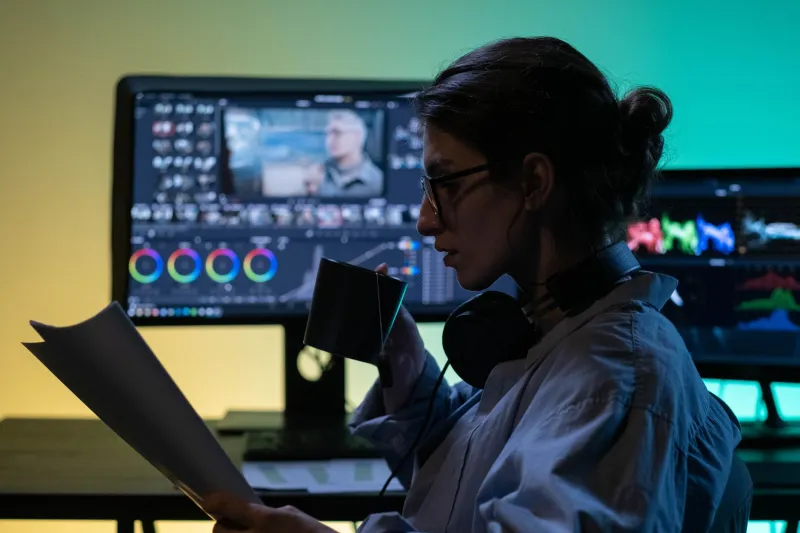
There is a moment in nearly every film that stops you cold — a cut that arrives a half-second earlier than expected, a silence held just long enough to ache, a scene that ends not on a line of dialogue but on a face. These are not accidents. They are decisions, made in darkened editing suites by craftspeople whose names rarely appear on posters or in awards-season conversation. And a significant number of those craftspeople are women.
Film editing occupies a peculiar position in the cultural imagination of Hollywood. It is simultaneously acknowledged as one of cinema's foundational arts and treated as invisible infrastructure — the plumbing behind the walls of a beautiful house. The director is celebrated. The cinematographer is photographed. The editor, more often than not, is thanked in an acceptance speech and promptly forgotten. For women editors, this invisibility compounds: their labor shapes the films audiences love most, yet the critical conversation rarely follows the cut back to its source.
The Architecture Nobody Sees
To understand what editors actually do, it helps to dispense with the common misconception that editing is simply the act of removing what does not belong. Editing is construction. It is the sequencing of time, the calibration of emotional temperature, and the management of narrative momentum across the full length of a feature. An editor decides not just which take survives but where the audience's attention is directed in any given moment — and by extension, whose interiority the film chooses to honor.
That last point carries particular weight when examining films centered on women's experiences. A male character's reaction shot, held for three seconds, communicates gravity and consequence. A female character's reaction shot, trimmed to one second before cutting away, communicates that her internal life is transitional rather than central. These are not ideological proclamations made in preproduction meetings. They are granular, cumulative choices made in post, and they add up to something the audience absorbs without ever quite naming.
This is precisely why the gender of an editor matters — not as a guarantee of any particular outcome, but as a variable that shapes the sensibility brought to those thousands of micro-decisions.
Rhythm as a Feminist Tool
Consider the work of Mary Jo Markey, whose editorial collaborations with J.J. Abrams have demonstrated a consistent attentiveness to the interior lives of female characters under pressure. Or look to the career of Carol Littleton, whose work on E.T. the Extra-Terrestrial and Body Heat established a model of editing that privileges emotional coherence over kinetic spectacle — a distinction that, while not exclusively feminist, aligns with a broader commitment to interiority that women-centered filmmaking frequently demands.
More recently, editors like Myron Kerstein — whose work on Crazy Rich Asians and In the Heights demonstrates an extraordinary facility for tonal multiplicity — have shown how the editing suite can hold comedy, longing, and cultural specificity in the same frame without collapsing any of them. The ability to sustain tonal complexity without resolving it prematurely is, arguably, one of the most undervalued skills in American commercial cinema, and it is a skill that demands genuine empathy for the full range of a character's experience.
Juliette Welfling's editorial work, similarly, reflects a sensibility attuned to the rhythms of female friendship and the specific textures of women's grief and desire — moments that Hollywood has historically either rushed past or sentimentalized into abstraction. Welfling's cuts tend to linger in the spaces between speech, trusting the audience to sit with ambiguity rather than resolving it into easy legibility.
The Scene That Changes Everything
Perhaps the most instructive way to understand editorial power is to examine what changes when a single sequence is re-cut. Imagine a scene in which a woman confronts a colleague who has undermined her professionally. Shot conventionally, the scene might cut between the two characters in standard over-the-shoulder exchanges, ending on the colleague's defensive response — effectively centering his discomfort as the scene's emotional conclusion.
An editor attentive to the woman's experience might make an entirely different set of choices: holding on her face after she speaks, allowing the audience to register not just what she says but what the act of saying it costs her. Cutting to her hands, briefly, before returning to her eyes. Ending the scene on her exit rather than on his reaction. None of these choices require a different script or a different director's vision. They require an editor who recognizes that the woman's interiority is the scene's true subject.
This is not a hypothetical. Versions of this choice are made in editing suites across Los Angeles every day, and the aggregate of those choices constitutes the emotional grammar of American cinema.
Recognition and Its Absence
The Academy of Motion Picture Arts and Sciences has awarded the Oscar for Best Film Editing to a woman exactly a handful of times in its nearly century-long history. That statistic is, by now, familiar to anyone who follows gender equity conversations in Hollywood — but its familiarity should not blunt its force. The editing branch of the Academy has historically skewed male, and the films that receive editing nominations tend to favor the kinetic and the conspicuous: the action sequence cut at machine-gun pace, the thriller edited to a razor's edge of tension. These are legitimate achievements. They are not, however, the full measure of what editing can do.
The subtler work — the grief held in a close-up, the friendship rendered in the rhythm of an exchange, the female protagonist's interiority given space to breathe — is harder to nominate because it is harder to isolate. It feels, to the inattentive viewer, like the natural consequence of a good performance or a well-written scene. That is, in a sense, the highest compliment one can pay an editor. It is also the mechanism by which their contribution disappears.
Toward a More Visible Craft
The growing presence of women in American film editing — and the increasing critical attention being paid to editing as a feminist practice — suggests that this invisibility is not permanent. Podcasts, academic journals, and film criticism outlets have begun to develop the vocabulary needed to discuss editorial choices with the same granularity applied to cinematography or production design. Organizations like American Cinema Editors have made meaningful strides in profiling the diversity of their membership.
But the most important shift may be the one happening in the editing suites themselves: a generation of women editors who understand their craft not merely as technical execution but as interpretive authorship. They are not simply assembling footage. They are deciding, cut by cut, whose experience American cinema chooses to take seriously.
That is not invisible labor. That is the film.