Framing Power: How Women Cinematographers Are Dismantling the Male Gaze One Shot at a Time
In 1975, film theorist Laura Mulvey introduced the concept of the male gaze — the argument that classical Hollywood cinema was structured around a masculine, heterosexual point of view that positioned women as objects of visual pleasure rather than subjects of their own narratives. Mulvey was writing about a specific historical moment, but the visual logic she described did not evaporate when the New Hollywood era ended. It persisted, evolved, and embedded itself so deeply into the conventions of American filmmaking that it became nearly indistinguishable from craft itself.
Half a century later, a generation of women directors of photography is doing the painstaking work of disentangling those two things: separating craft from convention, technique from ideology, and in doing so, building a new visual language for American cinema — one in which female bodies are lit, framed, and regarded on entirely different terms.
What the Camera Has Always Known
The male gaze, as a cinematographic practice, operates through accumulation. It is not typically one single shot of a woman's body presented as spectacle. It is the slow pan up from feet to face that arrives at a woman's eyes as an afterthought. It is the lighting scheme that softens and diffuses a female character's features while rendering her male counterpart in sharp, consequential chiaroscuro. It is the focal length choice that flattens a woman's form into decorative background while the narrative foreground belongs to someone else.
These are technical decisions. They are also ideological ones. And because they have been made predominantly by men — the American Society of Cinematographers remained overwhelmingly male for most of its history — they have calcified into a default mode that many viewers no longer consciously perceive as a choice at all. The male gaze, in this sense, has been naturalized: it feels like simply the way things look.
Women cinematographers are making it strange again. By making different choices — systematically, deliberately, and with full awareness of the tradition they are working against — they are making the camera's assumptions visible and, in doing so, dismantling them.
Light as a Political Act
Lighting is perhaps the most immediate site of this transformation. The conventional Hollywood approach to lighting women characters has historically prioritized what the industry calls "flattering" illumination: soft, diffused sources that minimize texture, smooth contour, and create an idealized surface. The effect is not incidental. It renders women visually pleasing and visually inert — beautiful objects rather than complex subjects.
Cinematographer Rina Yang, whose work has drawn significant critical attention in recent years, approaches lighting female subjects with a fundamentally different philosophy. Her lighting schemes tend toward harder sources and more pronounced shadow, creating faces that read as inhabited rather than displayed. The texture that conventional Hollywood lighting would erase — the lines, the asymmetries, the evidence of a life lived — becomes, in Yang's work, the primary carrier of character information. The woman on screen looks like someone who exists in time, not someone who has been suspended in a permanent present of visual availability.
Similarly, cinematographer Autumn Durald Arkapaw, whose credits include Loki and Tick, Tick... Boom!, has spoken publicly about her deliberate resistance to what she describes as the instinct to make everything "pretty." Her lighting choices consistently prioritize emotional legibility over aesthetic conventionality — a distinction that sounds subtle but produces images that feel categorically different from the Hollywood norm.
The Frame as a Statement of Value
Beyond lighting, compositional choices — where the camera sits in relation to a body, what it includes and excludes within the frame, how much space a woman is given within the image — constitute another dimension of this reclamation.
The male gaze tradition tends to fragment female bodies: a close-up of lips, a shot of legs, a composition that presents a woman as a collection of aestheticized parts rather than a coherent, self-possessed whole. The counter-tradition being established by women cinematographers tends, instead, toward integration. Bodies are framed completely. Characters occupy their space in the image with authority. The camera does not drift toward parts; it stays with the person.
This shift is particularly evident in how women cinematographers handle scenes involving female sexuality — historically among the most fraught terrain in American cinema. Cinematographer Charlotte Bruus Christensen's work demonstrates how intimate scenes can be shot with a camera that is attentive rather than voyeuristic, present rather than predatory. The difference lies not in what is shown but in the quality of the camera's regard: whether it watches a woman or watches for her, registering her experience as the scene's primary subject.
Color, Skin, and the Politics of the Grade
The conversation about the male gaze in cinematography cannot be complete without addressing color grading — the post-production process through which the final look of a film is established. American cinema has a long and troubling history of grading practices that privilege lighter skin tones, a legacy rooted in both racial bias and the technical limitations of early photographic emulsions that were calibrated primarily for white skin.
Women cinematographers, operating with a heightened awareness of whose bodies have historically been rendered invisible or distorted by the camera, have been at the forefront of pushing for more equitable grading practices. This includes advocating for the use of diverse skin tone references during lighting tests and color correction, ensuring that the full range of female bodies — across race, age, and physical form — is rendered with equal visual care and complexity.
The implications extend beyond representation as a moral imperative. When the camera is calibrated to see all women clearly, the visual language of American cinema expands. The range of female experience it can render becomes wider. The stories it can credibly tell become more various.
Building a New Default
The women reframing American cinema through their lens choices are not operating in isolation. They are part of a broader shift that includes the growing number of female directors, the increasing representation of women in film school faculty positions, and a critical culture that is developing more sophisticated tools for analyzing visual ideology.
Organizations like the American Society of Cinematographers have made commitments to increasing the visibility of women DPs, and initiatives like the Cinematography Mentorship Program have created pathways for women entering the field. These structural changes matter because the male gaze was never simply a matter of individual prejudice — it was a systemic default, reproduced by an industry that trained its practitioners in a particular visual tradition and rewarded them for adhering to it.
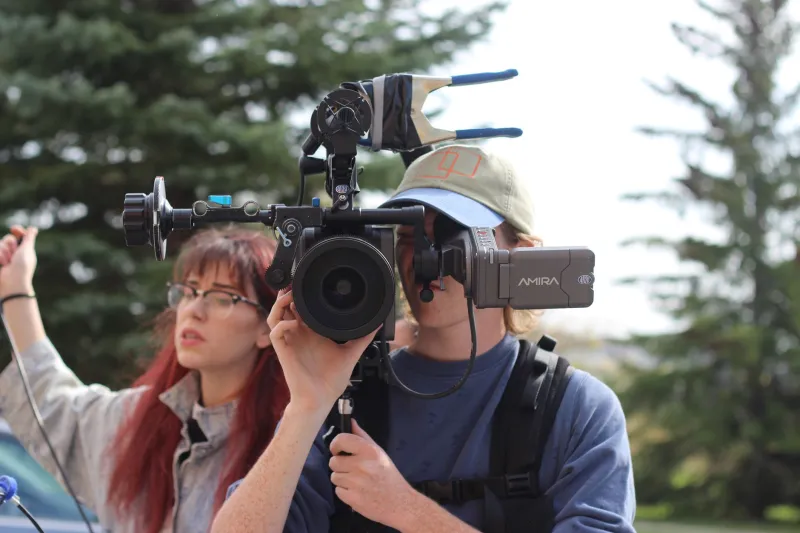
Changing that default requires more than exceptional individual work, though exceptional individual work is where it begins. It requires a critical mass of women behind the camera, making different choices consistently enough that those choices begin to constitute a new normal — a visual grammar in which female bodies are, simply and without argument, regarded as the full and complex human subjects they have always been.
The camera, after all, only sees what it is pointed at. The question has always been who is doing the pointing.