Written Out of History: The Long Fight to Put Women Screenwriters Back in the Frame
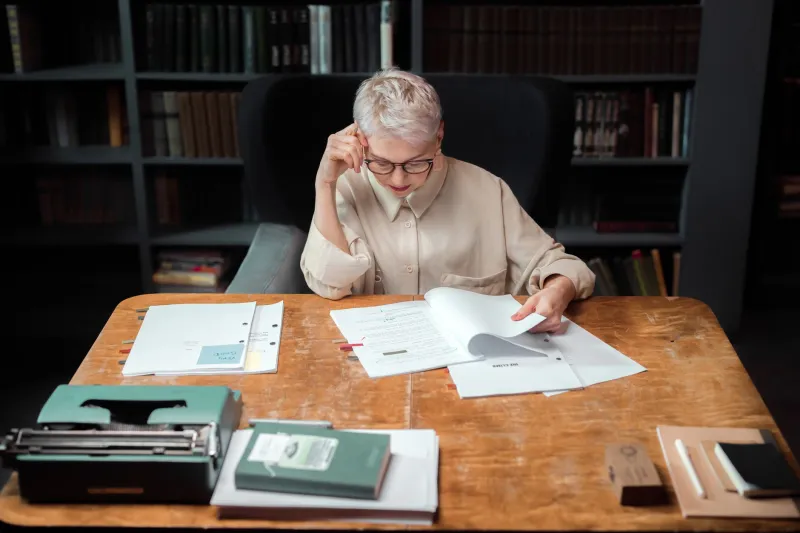
There is a particular cruelty in being the author of something you are not permitted to own. For generations of women who wrote for Hollywood—who crafted the dialogue, built the emotional architecture, and shaped the characters that audiences carried home with them—that cruelty was simply the cost of working in the industry. Their names were removed from credits, absorbed into collaborative pseudonyms, or quietly reassigned to male colleagues whose careers benefited accordingly. The erasure was rarely dramatic. It was bureaucratic, habitual, and devastatingly effective.
Today, that history is being reckoned with in ways both institutional and deeply personal. Women screenwriters are not only demanding recognition for the work they produce now—they are excavating what was taken from those who came before.
The Architecture of Erasure
To understand the present, it is necessary to sit with the past. During Hollywood's so-called Golden Age, women were disproportionately represented among the industry's writers. Figures such as Frances Marion, Anita Loos, and June Mathis were among the most commercially successful and critically respected screenwriters working in American film. Marion won two Academy Awards for Writing. Loos shaped the screwball comedy as a form. Mathis was instrumental in developing the epic scope of Ben-Hur.
And yet, as the studio system calcified and the cultural prestige of filmmaking rose, the industry reorganized itself around masculine authority. Writing became less associated with the domestic, intimate labor it had once been allowed to be, and more with the auteur—a figure almost exclusively imagined as male. Women did not disappear from screenwriting rooms, but they were steadily pushed toward the margins: credited less, paid less, and remembered almost not at all.
The mechanisms were not always explicit. Sometimes credit was negotiated away during contract disputes. Sometimes a producer simply reassigned a script. The Writers Guild of America, founded in 1933, created arbitration processes meant to protect writers—but those processes were themselves shaped by an industry culture that undervalued women's contributions. Even when a woman's work was formally acknowledged, the cultural narrative surrounding a film rarely centered her as its creative origin.
What the Record Omits
The consequences of this erasure extend beyond individual careers. When women are written out of film history, the stories they told are also, in a sense, misattributed. Audiences and scholars alike come to understand certain films through frameworks that do not account for the female perspective that actually animated them. The emotional intelligence that made a particular film resonate—the specificity of a female character's interiority, the subversive wit threaded through an ostensibly conventional plot—gets attributed to direction, to performance, to zeitgeist. Rarely to the woman who put it on the page.
This is not merely an academic concern. The stories we believe Hollywood has always told shape the stories we expect it to tell. When women's contributions are invisible, their absence appears natural rather than constructed. The industry's persistent underrepresentation of women writers—a problem that advocacy organizations such as the Writers Guild Foundation and the Annenberg Inclusion Initiative have documented extensively in recent years—is, in part, the inherited legacy of that constructed invisibility.
A New Generation Refuses Anonymity
Contemporary women screenwriters are operating in a landscape that remains unequal but is no longer entirely silent about that inequality. The #MeToo reckoning that shook Hollywood beginning in 2017 opened space for conversations about power and credit that had long been suppressed. Women writers began speaking publicly—in interviews, on panels, in industry trades—about experiences of having their work rewritten without acknowledgment, their pitches dismissed and later produced under other names, their credits minimized in marketing materials.
What distinguishes this moment is not simply the willingness to speak, but the structural organizing that has accompanied it. Women writers have increasingly leveraged the WGA's credit arbitration system, pushed for transparency in development processes, and built peer networks that make isolated incidents of erasure harder to sustain. The 2023 WGA strike, in which women were prominently represented among both the striking membership and the negotiating leadership, demonstrated that questions of credit and compensation are inseparable—and that women are no longer content to treat their invisibility as a private grievance.
The Page as Political Territory
Beyond the fight for credit lies a more expansive transformation: what women screenwriters are actually writing when they are given the latitude to write it. The shift is not simply demographic but narratological. When women control the page, the logic of whose experience constitutes a story worth telling begins to change.
Consider the evolution of female interiority on screen over the past decade. Films such as Lady Bird, written and directed by Greta Gerwig, or The Farewell, written and directed by Lulu Wang, center the emotional and psychological lives of women and girls with a granularity that had long been absent from mainstream American cinema. These are not films that simply feature women—they are films that take women's inner lives as their primary subject matter, treating that territory as inherently dramatic and universally resonant.
The same dynamic is visible in genre work. Women screenwriters bringing their perspectives to thrillers, horror, and science fiction are reshaping the conventions of those forms. The protagonist who survives not through physical dominance but through relational intelligence. The antagonist whose menace is rooted in recognizable social dynamics rather than cartoonish evil. The climax that resolves through emotional reckoning rather than violent catharsis. These are not departures from good storytelling—they are expansions of what good storytelling can encompass.
Recognition as Infrastructure
The fight for credit is, at its foundation, a fight for infrastructure. When a woman's name appears on a produced screenplay, she becomes legible to the industry in ways that generate future opportunities. She can be hired, referenced, championed, and taught. Her work enters the canon that shapes the next generation of writers. Credit is not vanity—it is the mechanism by which careers are built and traditions are established.
This is why the historical erasure of women screenwriters was so strategically damaging, and why its reversal carries such significance. Every woman whose name now appears on a major production, whose original screenplay gets greenlit, whose adaptation is developed with her vision intact, is not only advancing her own career. She is adding a data point to the record that the industry uses to determine who belongs.
American cinema has always been written by women, even when it pretended otherwise. The work of this moment is to make that truth impossible to ignore—and to ensure that the women writing the next chapter of that history are never again written out of it.