Holding the Mic: How Women Boom Operators Are Claiming Their Place in the Sonic Architecture of American Film
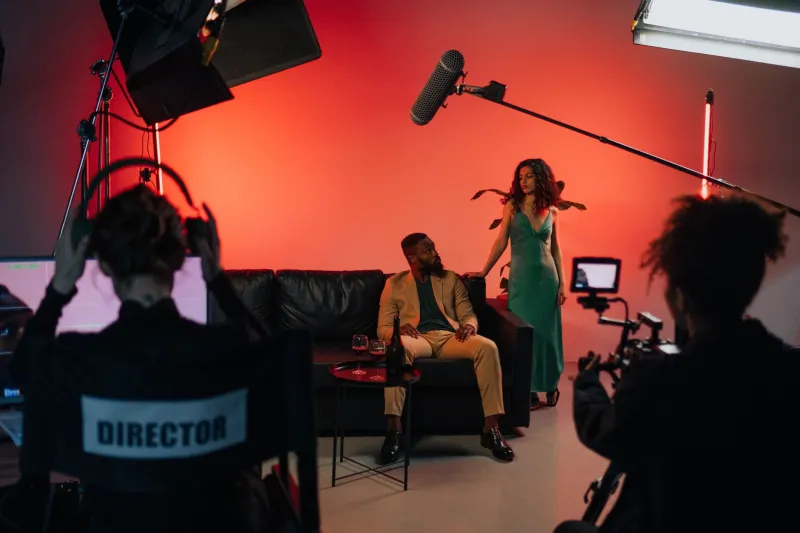
There is a moment in nearly every film — a whispered confession, a door closing on a marriage, a child's laugh cutting through ambient noise — where sound does what images alone cannot. It reaches inside the viewer and holds something there. That moment, in its purest form, belongs to the person holding the boom pole. And increasingly, that person is a woman who has spent years fighting to stand in that position.
Production sound is among the least visible crafts in American cinema. It operates in the background of behind-the-scenes culture, rarely celebrated in awards discourse and seldom profiled in the trade press. Yet without clean, precisely captured dialogue and environmental audio, no amount of post-production wizardry can fully rescue a scene. The boom operator is the first line of that sonic defense — and the women who occupy that role are beginning to speak loudly about what it has cost them to get there.
A Department Built on Exclusion
The sound department on a professional film set has historically been one of the most insular in the industry. Entry is often controlled through personal networks, union referrals, and informal mentorship chains that have, for decades, favored men. Women who have broken into production sound frequently describe the same pattern: initial skepticism about their physical capability, assumptions that they belong in the office rather than on the floor, and a persistent need to demonstrate competence that their male counterparts are rarely asked to perform.
The physical demands of boom operation are real. Holding a microphone pole overhead for extended periods, tracking actors across wide coverage shots, and maintaining spatial awareness in a crowded, fast-moving environment requires genuine endurance. But women in the field are quick to point out that physical capability has never been the actual barrier. The barrier has been perception — specifically, the assumption that physical labor on set is male territory by default.
What gets lost in that assumption is craft. Boom operation is not simply about keeping a microphone out of frame. It is about anticipating dialogue before it happens, understanding the acoustic properties of a given space, and making real-time decisions about mic placement that will shape every editorial choice that follows. The women who have built careers in this work describe it as intensely musical — a kind of performance that runs parallel to the one happening in front of the camera.
Sound as a Feminist Practice
When women do occupy positions of sonic authority on set, their influence can extend well beyond technical execution. Several women working as production sound mixers — the department heads who oversee all on-set audio capture — have spoken about the ways in which their presence changes how sound is prioritized in the production process.
In practical terms, this can mean advocating more forcefully for adequate rehearsal time before shooting begins, so that boom operators can map an actor's movement patterns and plan coverage accordingly. It can mean pushing back against the tendency to treat sound as a problem to be fixed in post rather than a craft to be honored on the day. And it can mean creating department cultures where newer crew members, including women entering the field for the first time, are trained rather than hazed.
This last point matters more than it might initially appear. The pipeline problem in production sound is not simply a matter of women choosing other departments. It is, in part, a function of hostile entry conditions. When the informal networks that govern hiring are closed, and when the on-set culture discourages women from returning, the pipeline does not fill. Women in senior sound roles who actively mentor junior crew members are doing structural work — rebuilding a ladder that was never designed to include them.
The Auditory Gaze
Feminist film theory has spent considerable energy examining the male gaze as a visual phenomenon — the way cameras have historically framed women's bodies for a presumed male viewer. Less attention has been paid to what might be called the auditory gaze: the ways in which sound design and production audio choices encode assumptions about whose voice matters, whose ambient world is worth capturing, and how female characters are sonically represented.
Women boom operators, working in close physical proximity to actors during performance, occupy a uniquely intimate position in this regard. The choices they make — which dialogue to prioritize in a two-shot, how much room tone to allow around a female character's voice, whether to capture the texture of a woman's breath during a moment of physical or emotional exertion — are not purely technical. They carry meaning. They contribute to whether a character sounds like a full human being or a flattened version of one.
This is not a claim that women automatically make better or more politically conscious sound decisions than men. It is a claim that representation behind the microphone, like representation behind the camera, produces a fuller range of choices — and that those choices accumulate into something that audiences feel even when they cannot name it.
Building the Next Generation
Organizations such as the Cinema Audio Society and various union-affiliated apprenticeship programs have made incremental progress in widening access to production sound careers. Women-specific mentorship initiatives within the sound community have begun to create the kind of informal networks that have long benefited male entrants to the field. These efforts are meaningful, even if they remain insufficient relative to the scale of the problem.
What the women doing this work are clear about is that technical excellence is not enough on its own. Visibility matters. When a woman is seen holding the boom on a major studio production — when her name appears in the credits of a film that gets reviewed, discussed, and remembered — it signals to the next woman considering the field that the door is not simply ajar, but genuinely open.
American cinema is made of sound as much as it is made of light. The women who are fighting to shape that sound deserve to be heard — in every sense of the word.