Time as Resistance: How Women Film Editors Are Using Rhythm to Reclaim the Female Gaze
There is a moment in Chloé Zhao's Nomadland—edited by Joshua James Richards in close creative collaboration with Zhao herself—where Fern, played by Frances McDormand, simply sits beside a river. Nothing advances. No plot mechanism triggers. The scene breathes, expands, and then contracts on its own terms. For audiences trained by decades of commercially driven editing to expect propulsion, the pause registers as almost transgressive. That discomfort is, in many ways, the point.
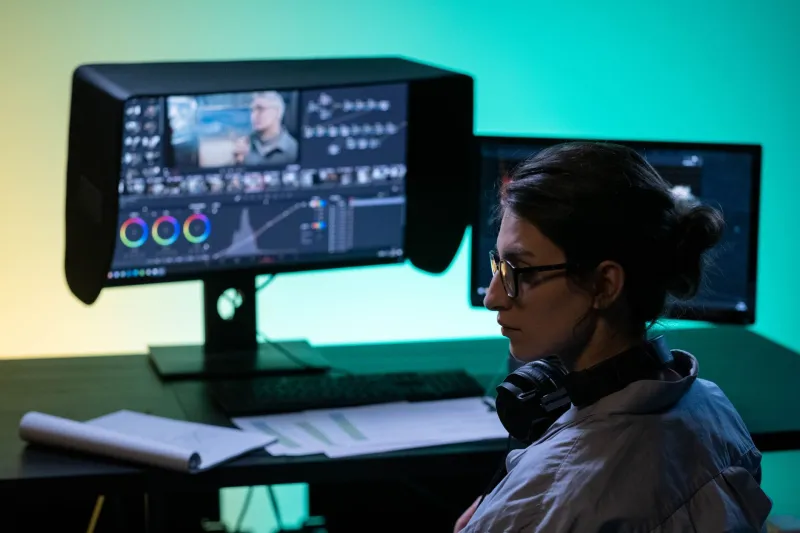
Editing is cinema's most misunderstood craft. It is the art of time itself—of deciding not merely what audiences see, but how long they are permitted to see it, and what emotional residue a cut leaves behind. For most of Hollywood's history, that art has been shaped by a predominantly masculine sensibility: fast, propulsive, externally focused, designed to drive narrative forward rather than inward. Women editors working across American cinema today are challenging those inherited rhythms with quiet, structural precision—and the results are reshaping how female characters are experienced on screen.
The Tempo of Male Gaze
To understand what women editors are pushing against, it helps to understand what dominant Hollywood pacing has historically produced. The continuity editing system—assembled in the early twentieth century and refined through decades of studio production—prioritizes efficiency. Scenes are cut to their functional minimum. Emotion is implied rather than inhabited. The camera and the editor conspire to keep audiences oriented in space and moving forward in time.
This efficiency has a gendered dimension. When female characters are edited according to the same logic applied to action sequences or chase scenes, their interiority becomes collateral damage. A woman's hesitation, her grief, her desire—these states require duration to register authentically. When the cut arrives too quickly, the audience is denied the experience of inhabiting her consciousness. They observe her from the outside. The gaze, in this sense, is not merely visual; it is temporal.
Feminist film theorists have long argued that the male gaze operates through the camera lens. What receives less attention is how that gaze is reinforced—or subverted—in the editing room.
Sitting with the Feeling
Anna Boden, co-director and editor of Half Nelson (2006), constructed that film's emotional architecture around a refusal to rescue audiences from discomfort. The scenes between Ryan Gosling's Dan Dunne and Shareeka Epps's Drey are edited with an unusual willingness to linger—to allow silences to accumulate meaning rather than filling them with dialogue or musical cues. Drey's perspective, her watchfulness, her slow assessment of the adult world around her, is given temporal weight that transforms her from a supporting presence into a moral center.
This is not accidental. Boden has spoken in interviews about her instinct to resist the pressure to "clean up" a scene's ambiguity through cutting. Ambiguity, in her editorial philosophy, is not a problem to be solved—it is the substance of authentic human experience. For female characters in particular, that philosophy creates room for complexity that faster cutting forecloses.
Similarly, editor Mary Jo Markey's work on J.J. Abrams' productions has been widely discussed in technical terms—her precision, her command of large-scale sequences—but her contribution to intimate scenes is equally significant. In Star Trek (2009), her handling of the emotionally loaded exchanges between Spock and Uhura grants Uhura's agency a duration and emphasis that the script alone could not guarantee. The cut does not arrive the moment the scene's informational content is exhausted. It arrives when the emotional transaction is complete—a distinction that sounds small but registers profoundly on screen.
Montage as Interior Monologue
Beyond individual scene pacing, women editors have distinguished themselves through their use of montage as a vehicle for female subjectivity. Thelma Schoonmaker's lifelong collaboration with Martin Scorsese—which has produced some of American cinema's most celebrated editing—demonstrates how a woman's editorial intelligence can transform even male-centered narratives. But her influence extends beyond Scorsese's filmography into a broader editorial culture that she has helped shape across decades.
More recent examples are equally instructive. Joi McMillon's co-editing of Moonlight (Barry Jenkins, 2016) represents one of the most sophisticated deployments of rhythmic editing in contemporary American cinema. McMillon, the first Black woman nominated for an Academy Award in editing, worked with Jenkins to construct a film whose temporal structure mirrors its protagonist's fractured sense of self. The editing does not simply cut between scenes—it breathes between them, allowing silence and stillness to carry as much narrative weight as dialogue or image. The result is a film whose emotional architecture is inseparable from its editorial decisions.
What McMillon's work illustrates is that montage need not be the rapid-fire collision of images associated with Soviet-era technique or contemporary action cinema. In the hands of an editor attuned to interiority, montage can operate as something closer to interior monologue—a rhythmic structure that gives form to consciousness rather than event.
The Politics of the Long Take
One of the most visible ways women editors are challenging conventional pacing is through their relationship to the long take. Historically, the long take has been associated with directorial auteurism—Kubrick, Tarkovsky, Welles—and has often been deployed to create a sense of formal mastery or dread. Women editors are reclaiming its potential for a different purpose: vulnerability.
In Eliza Hittman's Never Rarely Sometimes Always (2020), edited by Scott Cummings but shaped by Hittman's own editorial instincts developed across her career, the camera holds on Sidney Flanigan's face during the film's devastating phone interview sequence for what feels, in the best sense, like an eternity. The refusal to cut away is an editorial act of solidarity—a decision that the audience must remain present with this young woman's experience rather than being offered the relief of a reaction shot or a scene change.
This is the politics of duration made visible. The long take, in this context, is not a display of technical virtuosity. It is an ethical stance.
Building a New Rhythm
What connects the editorial approaches of Boden, McMillon, Markey, and the many women working across American cinema today is not a single aesthetic but a shared commitment: the belief that female characters deserve the time to be fully known. That interiority is not a luxury to be trimmed in the name of pacing, but the very substance of what cinema, at its most powerful, can offer.
The editing room has long been described as the place where a film is truly made. If that is so, then the women reshaping its rhythms are not merely adjusting the tempo of individual films. They are changing the fundamental terms on which American cinema allows its audiences to encounter women—not as objects moving through narrative space, but as subjects inhabiting their own time.
In a medium defined by what it chooses to show, the decision about how long to look may be the most radical choice of all.