Beyond the Double: How Women Stunt Coordinators Are Rewriting the Physics of Female Danger on Screen
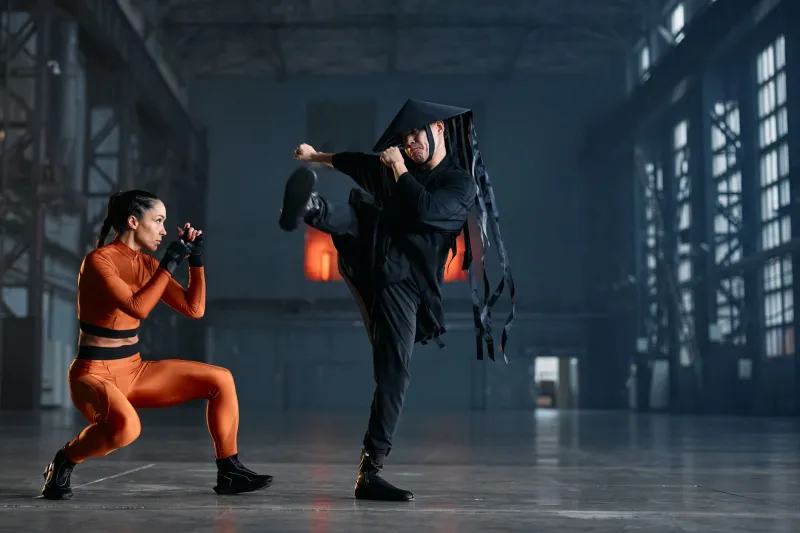
Action, in American cinema, has long been a language with a grammar built around men. The weight of a punch, the arc of a fall, the geometry of a car chase — these have been calibrated, refined, and mythologized through decades of stunt work designed primarily by and for male bodies. The women who now occupy the role of stunt coordinator are not simply inserting themselves into that existing grammar. They are rewriting it from the ground up.
This is work that happens largely out of public view. Stunt coordinators do not typically receive above-the-line credit, and the craft itself is still awaiting formal recognition from the Academy of Motion Picture Arts and Sciences, which has no competitive category for stunt coordination despite years of advocacy. Yet the influence of who designs action sequences — and from what physical and cultural perspective — is written into every frame of every fight, fall, and high-speed pursuit that American audiences consume.
What the Body Knows
The central argument that women stunt coordinators make, often simply by doing their jobs, is that female physicality is not a modification of male physicality. It is its own system, with its own strengths, vulnerabilities, centers of gravity, and ranges of motion. Action sequences designed without that understanding tend to produce one of two results: female characters who move like men in women's bodies, or female characters whose danger is staged as spectacle rather than agency.
Women who have risen to stunt coordinator positions describe the difference in practical terms. A fight choreographed for a woman who has, say, a background in gymnastics or martial arts looks different from one that simply scales down a sequence designed for a man. The angles are different. The use of momentum is different. The relationship between the body and the environment — a wall, a staircase, a moving vehicle — is different. When these differences are honored rather than flattened, the result is action that feels authentic in a way that audiences register even if they cannot articulate why.
This authenticity matters beyond aesthetics. When a female character's physical danger is staged with genuine understanding of her body, it communicates something about her as a person — her capabilities, her limits, her will. When it is not, even the most compelling performance by the actor in front of the camera can be undermined by stunt work that reduces her to a visual prop.
Safety as a Political Act
One of the most significant contributions that women stunt coordinators have made to the industry is a recalibration of how safety is discussed and prioritized on set. Stunt work carries inherent risk, and the culture around that risk has historically been inflected with a kind of performative toughness — an expectation that complaining about dangerous conditions is a sign of weakness, and that pushing through pain is a professional virtue.
Women entering the field have frequently described encountering this culture and finding it both dangerous and unnecessary. The technical tools and methodological rigor that allow stunt sequences to be performed safely without sacrificing spectacle have always existed. What has sometimes been missing is the willingness to use them consistently, particularly for female performers whose safety has not always been treated as a primary concern.
Women stunt coordinators who have built reputations for running safe sets describe this not as a softening of the work but as a form of professional integrity. A performer who is injured cannot complete the film. A performer who trusts her stunt coordinator will take risks more fully and with greater commitment. Safety, in this framing, is not the enemy of great action — it is its precondition.
Mentorship and the Stunt Pipeline
The stunt community in Hollywood has its own version of the network problem that affects virtually every below-the-line department: access is controlled by relationships, and relationships have historically been built among men. Women stunt performers who aspire to coordination roles have often found themselves excluded from the informal processes through which those opportunities are distributed.
The response from women who have broken through has been, in many cases, to build alternative pipelines. This means actively seeking out and recommending female stunt performers for work, creating training environments where women can develop the full range of skills — driving, fighting, falling, rigging — that stunt coordination requires, and making the case to directors and producers that a female stunt coordinator brings specific value to projects centered on female characters.
This last point is increasingly being heard. As studios invest in female-led action franchises and as audiences demonstrate appetite for action sequences that feel genuinely grounded in women's experience, the argument for women behind the coordination desk has become easier to make. The work of building that argument, however, has been done almost entirely by the women themselves.
Redefining What Danger Looks Like
Perhaps the deepest shift that women stunt coordinators are driving is conceptual. American action cinema has tended to equate danger with a particular aesthetic — large-scale destruction, brute physical force, a kind of operatic excess that signals stakes through volume. Women designing action sequences have often brought a different sensibility: an interest in precision over scale, in the psychological dimensions of physical conflict, in danger that feels genuinely personal rather than abstractly spectacular.
This does not mean that women-designed action is quieter or smaller. It means that it can be — and that the choice to make it so is a legitimate artistic decision rather than a budgetary limitation or a failure of imagination. When a fight sequence communicates character, history, and consequence alongside physical choreography, it is doing more than most action cinema has traditionally asked of itself.
The women stunt coordinators who are building careers in American cinema are doing precisely that — asking more. From the industry, from their collaborators, and from the stories that American film tells about what it means for a woman to be in danger, to fight back, and to survive.